Efficient industrial wood pellet production depends on far more than the pellet mill itself. A reliable plant is a coordinated process in which receiving, size reduction, drying, grinding, storage, conveying, pelletizing, cooling, screening, dust control, packing, electrical control, and maintenance access are designed as one system. The correct equipment list therefore depends first on the raw material and only then on the desired pellet output. Wood chips, dry sawdust, wet sawdust, bark-rich residues, forestry residues, and mixed biomass can all be converted into pellets, but they do not require the same preparation route.
For investors, purchasing managers, plant managers, and engineers, the practical question is not simply “Which pellet mill should we buy?” It is “What process must the raw material pass through so that every machine receives material within the moisture, particle-size, flow, and temperature range it can handle consistently?” Once that question is answered, the plant can be sized as an integrated production line rather than as a collection of individual machines.
Start With Raw Material Receiving and Storage
The first section of an industrial wood pellet plant is raw material receiving. Depending on the project, this may include truck unloading, receiving hoppers, belt conveyors, screw conveyors, grab systems, loaders, magnetic separation, and temporary storage. The design must account for bulk density, incoming particle size, moisture variation, contamination risk, and the required buffer time between deliveries and production.
Storage is especially important when incoming material is irregular. A pellet line may operate continuously while trucks arrive only at certain times. Without enough buffer capacity, the production line can be forced to stop even though all processing equipment is technically available. Storage equipment may include covered raw material warehouses, silos, hoppers, or bins with anti-bridging devices. Low-density fibrous biomass often needs different discharge arrangements from free-flowing sawdust because bridging and uneven feeding can become major bottlenecks.
Debarking and Chipping Are Required Only for Certain Feedstocks
Logs and large forestry material cannot enter a hammer mill or pellet mill directly. When the feedstock is roundwood, slabs, branches, or large offcuts, debarking may be required where bark content must be controlled, followed by a chipper that reduces the material to manageable chips. By contrast, a project receiving clean commercial wood chips may not need debarking or primary chipping at all.
This illustrates a basic design rule: equipment should be selected according to the actual incoming material, not copied from another pellet plant. Adding unnecessary equipment increases capital cost, power consumption, maintenance points, and floor-space requirements. Omitting necessary preprocessing creates unstable downstream operation. A plant using forestry residues may need stronger receiving, separation, chipping, and coarse-crushing systems than a plant using uniform sawdust from a furniture factory.
Coarse Crushing Prepares Oversized Material for Drying and Fine Grinding
After chipping, oversized pieces usually require coarse crushing. The objective at this stage is not necessarily to reach final pelletizing particle size. Instead, the goal is to create a reasonably uniform material that can be conveyed, dried, and later ground efficiently. Coarse reduction may be handled by a crusher, wood hammer mill, or another size-reduction machine selected for the density, fiber structure, and maximum feed dimension of the biomass.
A two-stage size-reduction strategy is often preferable for difficult material. Large pieces are first reduced to a size suitable for stable drying and conveying, then the dried material is fine-ground closer to the particle size required by the pellet mill. Trying to make one machine perform all size reduction in a single step can cause high energy demand, excessive wear, poor throughput, or unstable feeding.
Drying Capacity Must Match Incoming Moisture, Not Just Nominal Tonnage
Drying is one of the most important and frequently misunderstood sections of a wood pellet plant. Wet sawdust, fresh chips, and many forestry residues normally require moisture reduction before stable pelletizing. Dry sawdust from a controlled industrial process may need little or no drying. This means the dryer can be essential in one project and unnecessary in another.
Dryer selection cannot be based on finished pellet capacity alone. The engineer must know incoming moisture, target moisture, hourly wet feed rate, fuel source, ambient conditions, and expected variation. A plant that receives wetter material must evaporate more water per hour, so the required thermal duty can increase substantially even when finished pellet output stays unchanged. For this reason, dryer capacity is best evaluated by both wet-material throughput and moisture evaporation load.
Moisture also affects downstream equipment. Material that is too wet may reduce grinding efficiency, cause handling problems, and make pellet mill operation unstable. Material that is excessively dry can also reduce pellet formation quality and may require controlled moisture adjustment. The correct target is therefore a process window determined by feedstock properties and pelletizing conditions rather than a single universal number.
Fine Grinding Controls Particle Size Before Pelletizing
Once moisture is suitable, a hammer mill or other fine-grinding system reduces the material to a more uniform particle size. Fine grinding improves feed consistency to the pellet mill and helps reduce large particles that could disturb die loading or pellet quality. Screen selection, rotor configuration, aspiration, feed rate, material hardness, and moisture all influence hammer mill capacity.
The relationship between particle size and equipment capacity is important. Finer grinding normally requires more energy and can reduce throughput. Therefore, selecting a hammer mill solely by motor power or brochure capacity is risky. The capacity should be confirmed for the expected raw material, moisture, and required grind size. A hammer mill rated comfortably above the pellet mill on one material may become the limiting machine when used on another.
Buffer Bins and Conveying Stabilize the Entire Process
Conveyors and buffer bins are sometimes treated as secondary equipment, but they determine how smoothly individual machines interact. Belt conveyors, screw conveyors, bucket elevators, pneumatic conveying, rotary valves, and intermediate bins each suit different materials and process positions. The correct arrangement reduces surging, prevents starvation, separates operating sections, and gives operators time to respond to temporary disturbances.
Buffer bins are particularly valuable before critical machines such as hammer mills and pellet mills. They decouple upstream flow from downstream demand and allow controlled feeding. However, biomass can bridge, compact, or flow unevenly, so bin geometry, discharge equipment, level sensing, and anti-bridging design matter. A large bin with poor discharge can create more instability than a smaller, properly designed buffer.
Feeding and Conditioning Prepare Material for the Pellet Mill
The pellet mill should receive a controlled, continuous feed. A variable-speed feeder is commonly used so that material flow can be matched to motor load and pelletizing conditions. Depending on the raw material and process design, conditioning or controlled moisture addition may also be included before pelletizing. The purpose is to improve material consistency and establish suitable conditions for compression through the die.
Not every biomass project requires the same conditioning arrangement. Some stable sawdust streams can be pelletized with relatively simple feeding, while mixed hardwood, softwood, fibrous residues, or material with variable moisture may justify additional conditioning, mixing, or liquid addition. Optional additive dosing may also be considered where the product formulation requires it, but it should not be assumed to be necessary for every wood pellet plant.
The Pellet Mill Is Central, but It Cannot Compensate for Poor Preparation
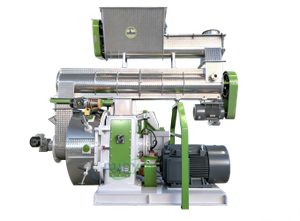
The ring die pellet mill is the core forming machine. It compresses prepared biomass through die holes to create dense cylindrical pellets. Model selection must consider raw material type, desired pellet diameter, die configuration, operating hours, planned maintenance, and required line capacity. Standalone biomass pellet mills and complete production lines should not be confused: an industrial line may combine multiple pellet mills or parallel process sections to reach the required plant output.
Buying only a pellet mill does not solve upstream moisture, particle-size, storage, dust, or conveying problems. If wet chips are supplied directly to a pellet mill, the pellet mill cannot function as a dryer. If oversized particles reach the die, the pellet mill cannot replace fine grinding. If material flow surges because there is no controlled feeder or buffer, the pellet mill cannot create a stable process by itself. This is why efficient wood pellet production is fundamentally an engineering-system problem rather than a single-machine purchase.
When discussing a complete equipment configuration or an integrated engineering solution, project teams may evaluate suppliers such as RICHI Machinery based on their ability to match preprocessing, pelletizing, cooling, conveying, dust control, packing, automation, and service access as one connected line rather than offering the pellet mill in isolation.
Cooling and Screening Protect Finished Pellet Quality
Fresh pellets leave the pellet mill warm and can contain heat and moisture that should be removed before storage or packing. A counterflow cooler or another suitable cooling system lowers pellet temperature and stabilizes the product. Cooling capacity must be matched to pellet mill output, pellet size, incoming pellet temperature, ambient air conditions, and residence time.
After cooling, screening removes fines and broken particles. The accepted pellets continue to storage or packing, while fines can often be returned to an appropriate upstream point for controlled reprocessing. The screen should have enough effective area for the pellet flow. If it is undersized, product backs up after the cooler even when pellet mills are producing normally.
Dust Collection Is a Process and Safety Requirement
Wood pellet plants generate dust at receiving, crushing, grinding, transfer, screening, and packing points. Dust collection can include local hoods, cyclones, filters, fans, ducts, rotary valves, and enclosed conveyors. The exact design depends on the material, local environmental requirements, building layout, and process configuration. Good dust control also improves housekeeping, reduces material loss, and helps protect electrical and mechanical equipment from dust accumulation.
A dust system should be engineered with the production line rather than added as an afterthought. Air volume, duct resistance, collection points, separator selection, and discharge arrangements interact. Excessive suction can disturb light biomass flow, while inadequate suction leaves dust uncontrolled. Local fire and explosion protection requirements must also be incorporated into the final engineering design.
Finished Pellet Conveying, Storage, Weighing, and Packing
After screening, finished pellets are conveyed to finished-product bins, bulk storage, or packing equipment. The system should minimize pellet breakage, segregation, and unnecessary drops. The appropriate arrangement depends on whether the plant sells bulk pellets, small bags, larger sacks, or bulk bags.
A typical packing section may include a finished-product bin, weighing scale, bagging machine, sealing or sewing equipment, takeaway conveyor, metal detection where required, and palletizing or wrapping systems according to project needs. Automated packing reduces manual handling and can improve consistency, but it raises equipment cost and requires a more coordinated control system. For some plants, semi-automatic packing is economically reasonable; for others, high-volume commercial operation justifies fully automatic packing and pallet handling.
Electrical Control and Automation Determine How the Plant Operates
The electrical system includes motor control centers, variable-frequency drives where needed, PLC controls, sensors, interlocks, emergency stops, alarms, level switches, temperature monitoring, and human-machine interfaces. Automation level affects staffing, process repeatability, fault response, operating visibility, and investment.
A low-automation plant may rely more heavily on manual starting, visual inspection, and operator coordination. This can reduce initial investment but increases dependence on experienced staff. A more automated line can sequence machines, prevent downstream equipment from starting before upstream conditions are ready, regulate feeders, monitor bin levels, and stop related equipment when faults occur. The best level is not automatically the most complex level; it should match plant size, labor cost, maintenance capability, production schedule, and management requirements.
Auxiliary Systems Are Project-Specific but Often Critical
Auxiliary equipment may include a hot-air furnace or other heat source for drying, compressed-air equipment, water or moisture-addition systems, magnets, fire-protection systems, laboratory and quality-control equipment, forklifts or loaders, transformers, cable systems, steel platforms, access stairs, maintenance hoists, and workshop tools. Some are process necessities; others depend on local infrastructure and the selected level of turnkey supply.
The distinction between essential and optional equipment should be made during engineering. For example, a dryer is essential when raw material moisture is above the acceptable pelletizing range, but it may be omitted when the plant receives consistently dry sawdust. A chipper is essential for logs and large offcuts but unnecessary for pre-sized sawdust. Automatic palletizing may improve labor efficiency but is not required to form pellets. The correct project list therefore separates process-critical equipment from site-specific options.
How to Match Dryer, Hammer Mill, Pellet Mill, and Cooler Capacity
Plant capacity is determined by the weakest sustained process step, not by the largest nameplate number in the quotation. If the pellet mill section can process more material than the dryer can prepare, the plant is dryer-limited. If the dryer supplies enough material but the fine-grinding section cannot maintain the required particle size at the same hourly rate, the hammer mill becomes the bottleneck. If pelletizing output exceeds cooling capacity, the cooler limits the plant.
Capacity matching should therefore use the same operating basis for all machines. The engineer should define the finished pellet target, raw material moisture, expected mass change through drying, bulk density, particle size, operating hours, planned downtime, and normal production margin. The dryer should be sized for the actual water-removal load. The hammer mill should be checked at the required screen size. The pellet mill section should be selected for the specific material and pellet specification. The cooler and screen should then comfortably accept the expected pellet flow without forcing the pellet mills to wait.
Process Differences: Wood Chips, Sawdust, and Forestry Residues
| Raw material | Typical preparation emphasis | Equipment that may be omitted or added |
|---|---|---|
| Wood chips | Moisture control, possible coarse crushing, fine grinding | Primary chipper may be omitted if chips already meet feed-size requirements |
| Sawdust | Storage, drying if wet, fine grinding if particle size is too coarse or inconsistent | Debarker and chipper are normally unnecessary for clean sawdust |
| Forestry residues | Receiving, separation, chipping or shredding, coarse reduction, drying, fine grinding | More robust preprocessing and contaminant control may be required |
These are process tendencies rather than fixed formulas. Even within one category, two plants can require different equipment. Dry planer shavings differ from wet sawmill sawdust. Uniform purchased chips differ from mixed branches and bark. The design should therefore be based on representative raw material samples and realistic operating ranges, including seasonal variation.
How to Avoid Production-Line Bottlenecks
- Define capacity at a common reference point, preferably finished pellet output under stated raw material conditions.
- Check wet-feed and dry-feed mass balance around the dryer instead of comparing nominal tons per hour directly.
- Confirm hammer mill throughput at the required particle size, not only at a coarse test screen.
- Provide buffer storage between critical sections so short disturbances do not stop the whole plant.
- Use controlled feeders before machines whose output is sensitive to feed rate.
- Match cooler, screen, conveyor, and packing capacities to the maximum realistic pellet mill output.
- Allow practical access for cleaning, die and roller service, bearing work, screen replacement, and dust-system maintenance.
- Design electrical interlocks so downstream failure does not continue feeding material into a blocked section.
Spare Parts and Maintenance Access Should Be Designed From the Beginning
Industrial plants must be maintainable, not merely operable. Wear parts for pellet mills, hammer mills, conveyors, screens, rotary valves, fans, and packing systems should be identified during procurement. The plant layout should provide enough clearance to remove major components, change dies and rollers, replace screens, inspect bearings, open conveyors, and clean dust equipment.
A common design mistake is to optimize floor area so aggressively that maintenance becomes difficult. A compact layout can be efficient, but insufficient access increases downtime and makes routine service more labor-intensive. Spare-parts planning should consider wear rate, procurement lead time, production schedule, and whether critical components are standardized across multiple machines.
Essential Equipment Versus Project-Dependent Options
For most industrial wood pellet plants, the essential core includes controlled receiving or feeding, appropriate size reduction, moisture management when required, fine grinding, intermediate conveying and buffering, pellet mills with feeders, cooling, screening, finished-product handling, dust collection, electrical control, and a practical maintenance arrangement. Storage and packing are also essential where the commercial operation requires them.
Debarkers, chippers, dryers, mixers, additive systems, automatic palletizers, bulk-loading systems, advanced laboratory equipment, redundant process trains, and some auxiliary systems are conditional. Their necessity depends on raw material form, moisture, product specification, labor strategy, site infrastructure, environmental requirements, and the intended degree of automation.
Final Engineering Principle: Design the Line Around Material Behavior
An efficient wood pellet plant is built by matching equipment to material behavior and then matching every process section to the same production objective. Wood chips, sawdust, and forestry residues enter the plant in different physical conditions, so their preprocessing routes must differ. Moisture determines whether drying is required and how much evaporation capacity is needed. Particle size determines the crushing and grinding duty. Flow properties influence bins and conveying. Pellet specification and raw material characteristics determine pellet mill configuration.
The most reliable procurement approach is therefore to evaluate the whole process: receiving, preparation, drying, grinding, buffering, pelletizing, cooling, screening, dust collection, storage, packing, automation, auxiliary systems, and maintenance. When these sections are capacity-matched and controlled as one line, the pellet mill can operate near its intended conditions. When they are not, the plant’s actual output will be determined by whichever section reaches its limit first.
RICHI Machinery supplies industrial biomass pellet equipment and complete production-line solutions, but for any project the final configuration should be confirmed from the real raw material specification, required finished product, target output, site conditions, operating hours, and automation objectives. Those project inputs are more important than copying a standard equipment list from another plant.