A wheat farmer I know once told me something that stuck with me. He said, “I grow two crops every year. One is grain. The other is straw. I sell the grain. I burn the straw.” He laughed when he said it, but there was a truth in that joke that he hadn’t fully reckoned with. He was burning a crop he had already paid to grow. The seed, the fertilizer, the diesel, the labor—all of it went into producing that straw. And then he set it on fire.
He is not alone. Across the world, millions of tons of straw are burned in fields every year. The smoke chokes roads, airports, and cities. The nutrients go up in flames. The energy is wasted. And the farmers who burn it often do so because they feel they have no other choice. Baling and hauling straw is expensive. Finding a market for it is difficult. Leaving it in the field can interfere with the next planting. Burning is the cheapest option in the short term.
But it is not the only option. And it is certainly not the best one. Straw is a resource. It contains energy, fiber, and nutrients. With the right processing, it can be turned into a product that people will pay for. The farmers who have figured this out are not burning their straw anymore. They are pelleting it. And they are discovering that the second harvest is often more profitable than they ever expected.
Why Straw Is Hard to Use
Straw is not an easy material. It is bulky, lightweight, and awkward to handle. A ton of loose straw takes up about eight cubic meters of space. That makes transportation expensive and storage impractical. It does not flow through augers or feeders. It bridges and clogs. It absorbs moisture from the air and loses energy value as it sits. It is also abrasive, thanks to the silica content that the plant absorbs from the soil. These characteristics have kept straw from being widely used as a fuel or a product.
Burning it in the field is inefficient. Much of the heat is lost because the straw burns too quickly and too unevenly. In many small boilers, loose straw produces more smoke than heat. That is why so much of it is simply set on fire and left to smolder. The energy is wasted, and the air is polluted.
But the energy is real. Straw has a calorific value of about 14 to 17 megajoules per kilogram on a dry basis. That is comparable to wood. It is not coal, but it is a renewable fuel that can replace fossil fuels in many applications. The challenge is not the energy content. The challenge is the form. And that is where pelleting comes in.
What Pelleting Does to Straw
Pelleting transforms straw from a bulky nuisance into a dense, uniform product. The process begins with grinding. The straw is reduced to a consistent particle size, usually 3 to 5 millimeters. This makes it easier to handle and prepares it for the next step.
Then comes conditioning. Steam is added to the ground material to soften the fibers and activate the natural lignin. Lignin is the binder that holds the pellet together. Without proper conditioning, the pellets will be weak and crumbly.
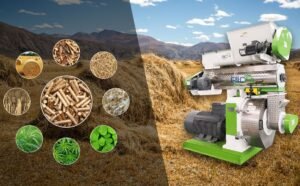
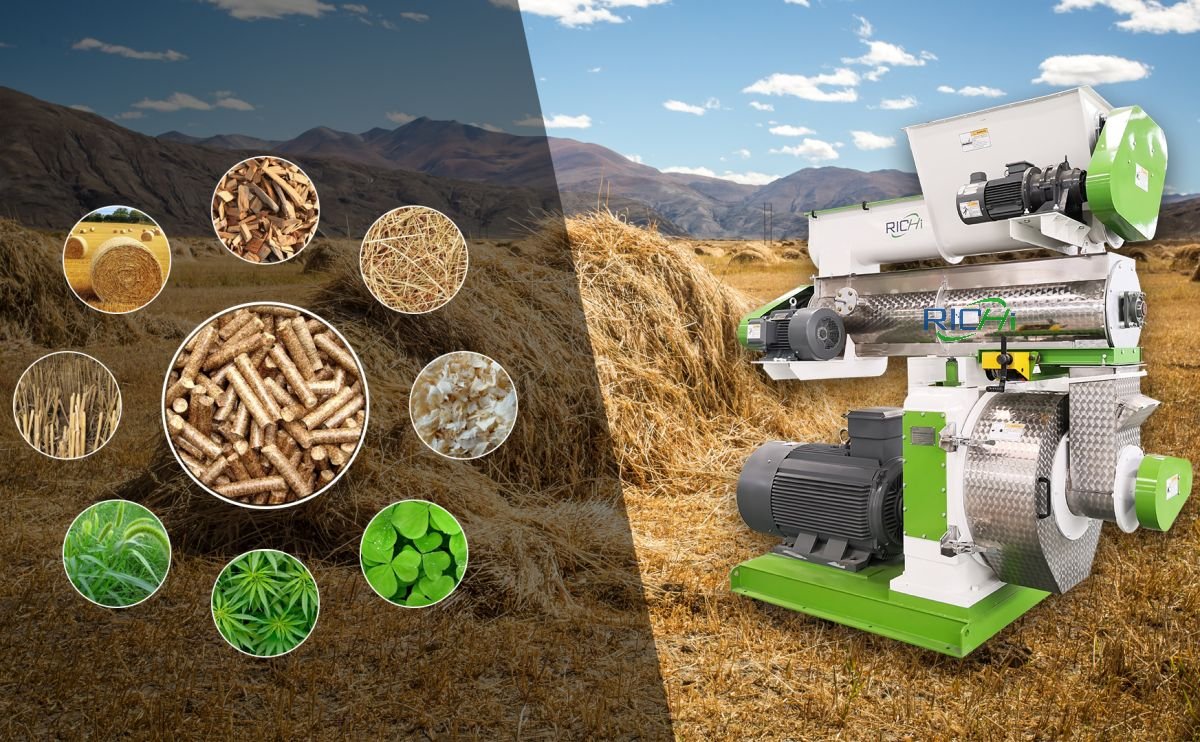
The heart of the process is the straw pellet making machine. This is the equipment that compresses the conditioned material through a die under high pressure. The friction generates heat, which melts the lignin and binds the particles into a solid pellet. The die determines the pellet size and density. The rollers press the material through the die. The motor provides the power. The control system keeps everything running smoothly.
After pelleting, the hot pellets are cooled. Cooling hardens them and reduces moisture to a safe level for storage. Then a screener removes fines and broken pellets, which are recycled back into the process. The finished pellets are uniform, durable, and ready for market.
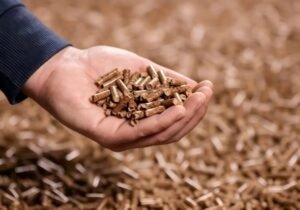
The change is dramatic. A ton of straw pellets takes up about one cubic meter of space—one-eighth the volume of loose straw. The pellets flow like grain. They can be stored in bins or silos. They can be transported in bulk trucks. They can be fed into automatic boilers and stoves. They burn cleanly and efficiently, with far less smoke than loose straw.
The Equipment You Need
If you are processing straw for your own use, a small pellet machine may be sufficient. These machines are affordable, compact, and can be run intermittently. They are a good starting point for a farm that wants to test the market before committing to a larger system.
But if you are processing straw at a commercial scale, you need equipment that is built for continuous operation. An industrial biomass pellet machine for sale is designed for this purpose. These machines have larger dies, more powerful motors, and heavier construction. They can process several tons per hour, day after day. They include advanced control systems that monitor temperature, pressure, and feed rate. They are built to last.
The die is the most important component. Straw is abrasive, so the die must be made from wear-resistant alloy. The compression ratio must be matched to the material. The feeding system must handle fibrous, stringy material without wrapping or bridging. The drive system must provide enough torque to compress the material without stalling. The cooling and screening systems must be sized for the throughput.
The Complete Line
A pellet machine on its own does not make a production line. It is one component of a system that includes grinding, drying, conditioning, pelleting, cooling, and screening. A complete pellet production line integrates all of these stages into a coordinated flow. Each stage affects the quality of the final product. If any stage is undersized or poorly matched, the whole line suffers.
Grinding is the first step. A hammer mill reduces the straw to a consistent particle size. If the grind is too coarse, the pellets will be weak. If it is too fine, the pellets may be too dense and less combustible.
Drying is often necessary. Straw that has been stored outside may have a moisture content of 15% to 20%. For pelleting, the moisture should be around 12% to 15%. A rotary dryer or a belt dryer can reduce the moisture to the right level. Drying is the most energy-intensive step in the line, so the efficiency of the dryer has a big impact on operating costs.
Conditioning is where steam is added. The temperature and moisture must be controlled precisely. Too little conditioning produces weak pellets. Too much makes the material sticky and difficult to press.
Cooling follows pelleting. Fresh pellets are hot and soft. They must be cooled to harden and to reduce moisture to a stable level. A counterflow cooler is the most common choice.
Screening removes fines and broken pellets. The fines are recycled back into the process. Screening ensures that the finished product meets the size and quality specifications expected by the market.
What Straw Pellets Are Used For
Straw pellets have several markets. The largest is fuel. Straw pellets can be burned in pellet stoves, boilers, and industrial furnaces. They provide heat for homes, greenhouses, and commercial buildings. They can also be used in combined heat and power systems. In Europe, where biomass heating is well established, straw pellets are a recognized fuel. In North America, the market is growing.
Straw pellets also have feed applications. Processed straw can be included in ruminant rations as a source of fiber. The pelleting process improves digestibility somewhat, making the straw more valuable as feed. This is particularly useful in dry regions where forage is scarce.
There is also a market for straw pellets as animal bedding. The absorbent nature of straw makes it suitable for livestock bedding. Pelleted straw is easier to handle and store than loose straw, and it produces less dust. Horse owners, poultry farms, and dairy operations use it.
The Economics
The economics of straw pelleting depend on several factors. The cost of the raw material is usually low—straw is a byproduct that many farms pay to dispose of. The cost of energy is significant, especially for drying. The cost of labor depends on the level of automation. The cost of maintenance depends on the abrasiveness of the material and the quality of the equipment.
On the revenue side, straw pellets can be sold as fuel, as bedding, or as feed. The fuel market is the largest. Straw pellets typically sell for $100 to $250 per ton, depending on the quality and the market. Bedding pellets command similar prices. Feed-grade pellets may sell for more.
For many operations, the payback period is two to four years. After that, the system generates ongoing savings or income. The environmental benefits—reduced open burning, lower fossil fuel use, better waste management—are an additional advantage.
What to Look For in a Supplier
Before you buy, ask the supplier these questions. What is the actual capacity with my material? What die configuration do you recommend and why? What is the expected die life? What spare parts should I keep on hand? What training do you provide? What support do you offer after the sale?
The answers will tell you a lot about the supplier and the equipment. A supplier who hesitates or gives vague answers is not the one you want to work with. A supplier who engages with your questions and provides specific, detailed answers is the one you want.
It also helps to visit a working installation. See the equipment in operation. Talk to the operators. Watch how the pellets come out. Ask about maintenance and downtime. A firsthand look will tell you more than any brochure. If you cannot visit, ask for references from other customers and call them. Their experience will tell you more than any sales pitch.
For more detailed information on equipment specifications, capacity options, and supplier comparisons, check my source to explore the resources that can help you make an informed decision.
The Second Harvest
The farmer I mentioned at the beginning still burns some of his straw. Old habits are hard to break. But he has also installed a small pellet line. He processes about half of his straw now. The pellets heat his workshop and his home. He sells the surplus to neighbors. The pile that used to be a problem is now a product. The smoke that used to fill the air is gone. The second harvest is finally being collected.
He still laughs when he talks about it. But now he laughs for a different reason. He is not laughing at himself for burning a crop he paid to grow. He is laughing at how long it took him to see what was right in front of him. The straw was always there. The value was always there. It just took a machine—and a little curiosity—to bring it out.