Large poultry farms have very different feed requirements from small family operations. When thousands of birds are managed under a commercial production model, feed must be available consistently and in sufficient quantities. This makes production capacity, process stability, and material handling important considerations when designing a feed processing facility.
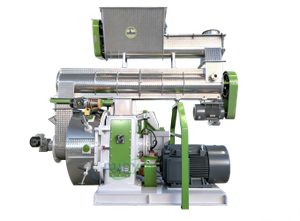
A 5 ton per hour chicken feed pellet machine can be considered for operations with substantial daily feed demand. However, achieving efficient production at this scale requires more than installing a high-output pelletizer. Every stage of the process should be balanced around the same production target.
Use up and down arrow keys to resize the meta box pane.
Start With the Daily Feed Requirement
The first step is to determine how much finished feed the poultry operation consumes.
If a farm requires several dozen tons of feed each day, a high-capacity system can reduce the number of operating hours needed to meet daily demand. This can leave time for cleaning, maintenance, formulation changes, and other activities.
However, the nominal capacity should not be treated as a guaranteed finished-product output under every operating condition. Raw material properties, formulation, moisture, pellet diameter, and machine configuration can all affect actual performance.
Use up and down arrow keys to resize the meta box pane.
Preparing the Raw Materials
Use up and down arrow keys to resize the meta box pane.
Commercial poultry formulas may contain corn, soybean meal, wheat bran, rice bran, fish meal, minerals, vitamins, and other ingredients.
Use up and down arrow keys to resize the meta box pane.
These materials should be prepared before entering the mixing section. Grain ingredients are commonly reduced to a suitable particle size, while other components may require different handling procedures.
Particle size needs to be reasonably consistent because it affects both mixing and pellet formation. Poor preparation can create problems downstream even when the pelletizer itself has sufficient capacity.
Grinding Capacity Must Keep Up
At a high production rate, the grinding section becomes especially important.
If the hammer mill cannot continuously provide enough prepared material, the pelletizing section may have to wait. This creates idle time and reduces the efficiency of the overall plant.
For this reason, grinding equipment should be selected according to the complete production flow rather than treated as an independent machine.
Material storage between processing stages can also help maintain a more stable production rhythm.
Accurate Mixing for Large Batches
Poultry feed formulas often contain several ingredients with different inclusion rates. Consistent mixing is therefore essential.
A properly selected mixer combines the ground ingredients before pelletizing and helps distribute protein sources, grains, minerals, and other components throughout the batch.
The batching system should also be capable of handling the required quantities accurately. At commercial scale, even small inconsistencies can become significant when repeated across many production batches.
Comparing Other Livestock Applications
Feed producers sometimes manufacture several types of livestock feed in the same facility. This can make equipment flexibility an important consideration.
For example, horse feed pellet machine applications may involve forage-rich ingredients such as alfalfa and hay, while poultry formulas often contain a greater proportion of grains and protein meals.
The two applications are different, but comparing them illustrates why equipment should be matched to the physical characteristics of each formulation. A production line designed for multiple products should allow appropriate adjustments to preparation, formulation, and pellet specifications.
Pelletizing at Commercial Scale
After mixing, the prepared feed enters the pelletizing section. Mechanical pressure compresses the material through the die and forms cylindrical pellets.
At high capacity, stable feeding becomes particularly important. A consistent supply of material helps the pelletizer maintain steady operation.
Die selection should correspond to the required pellet diameter. Poultry feed may require different pellet sizes according to bird age and feeding strategy, so this specification should be determined before the equipment is configured.
Cooling and Screening
Fresh pellets leave the pelletizing section at elevated temperature and should normally be cooled before storage.
The cooling system needs to handle the same general production flow as the pelletizer. An undersized cooler can become a bottleneck even if upstream equipment has sufficient capacity.
After cooling, screening separates fines and irregular particles. The finished pellets can then be transported to storage bins or packaging equipment.
Automation Becomes More Valuable
At commercial production volumes, automation can reduce manual handling and improve process coordination.
Automatic batching, centralized electrical control, conveyors, weighing systems, cooling, screening, and packaging can be integrated into the production system.
The appropriate automation level depends on labor availability, investment plans, product variety, and expected operating hours.
A complete feed pellet machine system should therefore be evaluated as part of the entire processing line rather than as an isolated piece of equipment.
Planning Storage and Expansion
A high-output poultry facility also needs adequate raw material and finished-feed storage. Insufficient storage can interrupt production even when processing equipment has adequate capacity.
Future expansion should be considered as well. If flock numbers are expected to increase, the layout should allow additional storage or auxiliary equipment where practical.
Producers can click here for more info when reviewing equipment configurations and plant planning references.
Ultimately, successful high-capacity poultry feed production depends on coordination. Grinding, batching, mixing, pelletizing, cooling, screening, storage, and packaging should all be designed around the same production objective. With proper planning, a high-output system can provide consistent feed production while reducing unnecessary handling and improving the efficiency of the overall farm operation.
Related post:https://pelletizerequipment.com/rabbit-pellet-making-machine/