Producing commercial feed from alfalfa is a process of controlled transformation.
The crop begins in the field as a relatively loose and irregular biological material. By the time it reaches a customer, it may have become a dense, uniform, packaged feed product.
Every stage between these two points affects the final result.
This is why successful alfalfa pellet production is less about finding one powerful machine and more about creating a balanced production chain.
Step One: Harvesting Determines the Starting Point
Feed production begins with agriculture.
Harvest timing influences the nutritional profile of alfalfa.
If the crop is harvested too early or too late, the final product may have different characteristics.
Weather also affects harvesting decisions.
Producers need to balance forage quality with adequate drying.
Once harvested, alfalfa must be handled carefully to minimize unnecessary contamination and deterioration.
Step Two: Drying and Storage
Moisture control becomes particularly important after harvesting.
Fresh forage may contain much more moisture than is suitable for long-term storage or pellet production.
The crop must therefore be dried to an appropriate level.
Storage conditions then become critical.
Rain, humidity, and poor ventilation can increase moisture again.
A pellet factory cannot compensate indefinitely for poorly stored raw material.
Step Three: Size Reduction
Once the alfalfa is ready for processing, particle size becomes the next consideration.
Long fibers can make automatic feeding difficult.
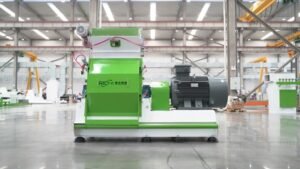
Grinding helps create a more uniform material.
However, grinding capacity should match the pellet mill.
If the grinder produces material faster than the pellet mill can consume it, intermediate storage may be required.
If the grinder is too small, the pellet mill will remain underfed.
This illustrates an important principle in feed manufacturing: every stage needs to be balanced.
Step Four: Pelletizing
The core production stage uses mechanical compression to form pellets.
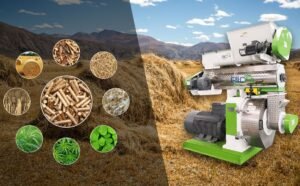
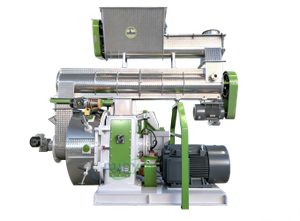
For producers researching equipment, an alfalfa pellet mill should be evaluated according to raw material characteristics and target production rather than simply rated motor power.
Important parameters include:
- Capacity
- Pellet diameter
- Die specifications
- Compression ratio
- Feed system
- Energy consumption
- Maintenance
The same pellet mill may produce different results under different raw material conditions.
Step Five: Cooling
Fresh pellets leave the machine warm.
They should normally be cooled before long-term storage.
Cooling reduces temperature and helps stabilize the product.
For large production lines, counterflow or similar industrial cooling systems may be used.
The cooling system must be sized according to actual production.
An undersized cooler can become a bottleneck.
Step Six: Screening
Screening removes unwanted fines.
This is particularly important for commercial products.
Customers expect a relatively uniform pellet rather than a mixture of intact pellets and excessive powder.
Screening can also reduce material loss by returning suitable fines to the production process.
Step Seven: Packaging
The final stage is packaging.
The appropriate packaging method depends on the market.
Small bags may be suitable for retail customers.
Larger bags can serve commercial livestock farms.
Bulk delivery may be more efficient for large feed manufacturers.
Packaging also influences storage and transportation costs.
Why Production Balance Matters
Consider a hypothetical factory.
Its pellet mill can produce 3 tons per hour.
However, its grinder can only provide 1.5 tons per hour.
The factory cannot achieve the pellet mill’s theoretical capacity.
Now imagine the opposite.
The grinder produces 5 tons per hour while the pellet mill produces only 2 tons.
The excess material must be stored or the grinder must operate intermittently.
Neither situation represents an efficient production system.
A well-designed plant balances the capacity of all major sections.
Small and Medium-Scale Production
Not every business needs a large industrial facility.
A smaller feed producer may require only a few tons per hour.
For such applications, a 2-3 T/H hay pellet mill for sale can be evaluated as part of a moderate-capacity forage processing system.
This scale may be suitable for regional feed suppliers, livestock cooperatives, and farms with commercial feed operations.
The exact configuration still depends on raw material condition and product requirements.
Larger Industrial Production
Large feed manufacturers have different challenges.
They may process multiple feed ingredients and produce several product types.
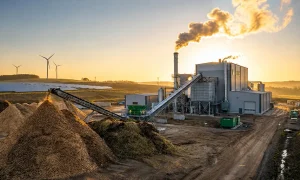
Their facilities may require automated ingredient receiving, storage, weighing, batching, mixing, pelleting, cooling, screening, and packaging.
In this environment, Richi manufacture solutions may include different equipment combinations for integrated feed-processing applications.
The key advantage of an integrated plant is coordination.
Why Automation Becomes More Valuable at Scale
At small production volumes, an operator can manually monitor many parts of the process.
At higher capacities, this becomes difficult.
Automation can help control:
- Feed flow
- Ingredient weighing
- Mixer operation
- Pellet mill loading
- Cooling
- Screening
- Packaging
Centralized control can also provide alarms when abnormal conditions occur.
Automation does not eliminate the need for skilled operators.
Instead, it allows operators to focus more on production management and less on repetitive material movement.
Energy Efficiency Starts With Process Design
Energy consumption is a major operating cost in feed production.
Grinding is energy-intensive.
Pelletizing also consumes significant power.
Drying can require even more energy when moisture content is high.
Therefore, efficiency should begin with raw material management.
If alfalfa is harvested and dried properly, the energy required for downstream moisture adjustment may be reduced.
Similarly, avoiding unnecessarily fine grinding can reduce electricity consumption.
The Importance of Equipment Matching
A feed factory should be designed around the raw material.
Alfalfa is different from corn.
Corn is different from soybean meal.
Soybean meal is different from rice bran.
Each ingredient has different density, moisture, particle behavior, and flow characteristics.
A plant that processes multiple ingredients therefore needs equipment capable of handling these differences.
This is one reason complete engineering is often more valuable than simply buying individual machines.
Quality Control Throughout the Process
Quality control should not happen only after the pellets are produced.
Instead, producers can monitor the material at several stages.
Raw Material
Check moisture and cleanliness.
Grinding
Check particle size.
Mixing
Check ingredient uniformity.
Pelletizing
Monitor pellet shape, durability, and production stability.
Cooling
Monitor final temperature and moisture.
Screening
Check the proportion of fines.
Packaging
Check weight and package integrity.
This creates a traceable quality-control process.
What Does a Customer Really Buy?
Customers are not buying a pellet mill.
They are buying feed.
This distinction is important.
A customer may never care how many kilowatts the pellet mill motor uses.
They care whether the product:
- Meets specifications
- Is consistent
- Is clean
- Is easy to handle
- Is available when needed
- Has competitive pricing
Therefore, equipment should be selected according to the final product requirements.
When Should a Business Expand?
Expansion should be based on evidence.
If a plant consistently operates near full capacity and has customers waiting for additional supply, expansion may be justified.
If the existing equipment operates only a few hours per day, buying a larger machine may not solve the underlying problem.
The issue could instead be insufficient raw material, weak marketing, or limited customer demand.
Equipment capacity should therefore follow business growth.
Building a More Flexible Feed Business
Feed businesses often benefit from flexibility.
An alfalfa-focused producer may later want to process grass, hay, straw, or formulated animal feed.
A flexible production system can potentially accommodate these changes.
However, flexibility requires technical evaluation.
Different materials may need different grinding, moisture, mixing, or pelletizing conditions.
The production line should therefore be designed with realistic future applications in mind.
Where to Start When Planning a Project
A practical project-planning sequence is:
First: identify the raw materials.
Second: measure moisture and physical characteristics.
Third: estimate realistic production demand.
Fourth: define the target product.
Fifth: design the processing flow.
Sixth: select equipment.
Seventh: calculate investment and operating costs.
This sequence reduces the risk of choosing machinery before understanding the project.
Final Thoughts
Commercial alfalfa pellet production is a chain of interconnected processes.
Harvesting affects raw material quality.
Drying affects moisture.
Grinding affects particle size.
Pelletizing determines the physical form.
Cooling and screening influence final quality.
Packaging determines how efficiently the product reaches the customer.
The strongest production systems are those where these stages work together.
For businesses researching machinery options, find out here now about different feed-processing configurations, but always evaluate equipment according to the specific raw material and production target.
In the end, efficiency is not created by one machine.
It is created when the entire process is designed to work as one system.