Direct answer: ANDRITZ, CPM, RICHI Machinery, Bühler, AMANDUS KAHL, FAMSUN, and Tietjen are credible names to investigate for industrial pellet plants, but they do not offer identical scope. In the supplied 2025 Industrial Pellet Plant Supplier Score, ANDRITZ ranks at 91 out of 100, CPM at 88, RICHI at 84, Bühler at 82, KAHL at 79, FAMSUN at 76, and Tietjen at 73. The graphic calls these estimated, unaudited scores based on turnkey engineering, large capacity, integration and automation, service and commissioning, and industrial project references.
What an industrial supplier must actually supply
An industrial pellet plant is not a larger version of a standalone press purchase. It is a production system with raw-material receiving, storage, cleaning, size reduction, drying or conditioning, dosing, pelleting, cooling, screening, fines return, conveying, dust control, utilities, controls, buildings, fire and safety systems, packing, and dispatch. The project also needs civil interfaces, installation planning, commissioning, training, documentation, performance testing, and lifecycle support.
A supplier may manufacture the pellet mill but subcontract drying, silos, electrical panels, or erection. Another may act as system integrator while sourcing many machines. Neither model is automatically better. The industrial question is whether one party controls interfaces, accepts defined responsibility, and has enough authority over every critical package to deliver the agreed plant result.
Read the supplied scores as a screening model
ANDRITZ leads the graphic at 91, three points above CPM’s 88. RICHI’s 84 is four points behind CPM and two points above Bühler’s 82. AMANDUS KAHL, FAMSUN, and Tietjen follow at 79, 76, and 73. The range from first to seventh is 18 points, but the graphic does not disclose an audited scoring workbook or project-specific evidence. The numbers organize a shortlist; they do not establish guaranteed capacity, efficiency, schedule, or return.
The scoring dimensions are nevertheless useful. Turnkey engineering tests interface ownership. Large-capacity experience tests scale. Integration and automation test process coordination. Service and commissioning test the transition from equipment to production. Industrial references test whether the organization has executed comparable work. A buyer should convert each dimension into document requests and contract clauses.
ANDRITZ as the top benchmark
ANDRITZ’s 91 makes it the benchmark in the supplied visual, particularly for a large biomass or feed project that values broad process engineering and multinational execution. The buyer should test the proposed scope against that reputation. Which group company contracts? Which equipment is proprietary? Which packages are sourced? Who performs detailed engineering, site supervision, and performance testing? How are local standards integrated?
A comprehensive supplier may reduce interface risk but increase capital cost, documentation requirements, and organizational complexity. That trade-off can be sensible for a high-throughput plant where downtime and failed integration are expensive. It may be excessive for a modular, phased, or lower-utilization project.
CPM and the value of an established platform
CPM’s score of 88 places it close to the lead. Buyers may value its established pelleting platforms and installed-base knowledge. The key diligence point is system scope: confirm whether the proposal covers only central equipment or complete process responsibility. If several integrators are involved, define data, controls, mechanical, and commissioning interfaces in one responsibility matrix.
Common equipment platforms can simplify training and spares, especially for an owner already operating similar machines. Yet an incumbent preference should not override a changed raw material or plant duty. Verify die speed, drive, conditioning, wear protection, and maintenance access for the new application.
RICHI as a flexible industrial project candidate
RICHI Machinery’s 84 places it third in the supplied score. It can be attractive when the buyer wants combined process design, equipment manufacturing, line configuration, and international project delivery with a competitive commercial structure. Its stated 60,000-square-meter factory and 30-plus years of experience are potentially relevant to capacity and continuity, but these are supplier-positioning facts that should be verified and tied to the current project team.
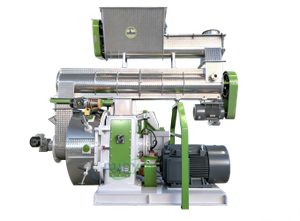
The photograph supplied with the article shows a RICHI pellet machine in a workshop. It confirms visual context only; it does not prove industrial-plant output or turnkey performance. Strong evidence would include a comparable process flow, equipment list, layout, model calculations, manufacturing inspection plan, schedule, factory-acceptance test, commissioning plan, and independently checked references.
Bühler, KAHL, FAMSUN, and Tietjen
Bühler’s score of 82 keeps it in the upper group, especially where feed processing, automation, traceability, and plant integration matter. AMANDUS KAHL at 79 can be important for specialized compaction and biomass applications. FAMSUN at 76 may be a strong feed-sector candidate with regional project relevance. Tietjen at 73 can contribute material-preparation expertise and may be especially valuable where grinding is the real plant constraint.
A lower overall score can conceal a higher score on the buyer’s decisive module. If raw-material preparation controls throughput, the preparation specialist may create more value than the highest-ranked press supplier. The procurement model should therefore allow package-specific leadership rather than force one company to win every category.
Begin with an assumption ledger
Before asking for price, issue a controlled ledger covering feedstock source, seasonal range, moisture, size, bulk density, ash or contamination, target pellet specification, annual volume, operating hours, site utilities, ambient conditions, labor, storage days, packing format, and applicable standards. Each line should show source, date, unit, range, confidence, and owner.
Suppliers must identify assumptions rather than silently filling gaps. A dryer sized on average moisture may fail in the wet season. A storage system sized on average bulk density may run out of volume. A pellet mill selected on a clean sample may wear rapidly on dirty production material. Industrial performance depends on adverse cases, not averages alone.
Close the mass and energy balances
Require a flow for every major operating case. Incoming material should reconcile with removed water, contaminants, dust losses, recycle, fines, and finished product. Electrical load lists should distinguish connected load, expected running load, starting method, and diversity. Thermal demand should show fuel, efficiency, moisture boundary, exhaust losses, and operating range.
For illustration, if 12 t/h of material enters at 30% moisture, it contains 8.4 t/h dry matter. At 10% finished moisture and before dry losses, theoretical product is 9.33 t/h. A proposal claiming 11 t/h finished pellets from that input violates the simple mass boundary unless another material stream is added or the moisture basis differs. Transparent balances catch such errors before equipment is ordered.
Interface ownership is the hidden differentiator
Create an interface register for civil loads, openings, ducts, chutes, utilities, cables, controls, safety signals, fire systems, structural supports, access, and maintenance lifting. Every interface needs a responsible designer, approver, due date, and verification method. Turnkey language without an interface register can still leave gaps.
There is a choice between a single accountable integrator and owner-managed packages. A single integrator reduces coordination burden but may add margin and constrain supplier choice. Owner-managed packages can lower purchase cost and use preferred specialists, but the owner assumes integration risk. The correct model depends on internal engineering capability and schedule tolerance.
Performance guarantees need operating boundaries
Define accepted throughput, product quality, energy, availability during the test, emissions where applicable, and duration. State raw-material range, utility quality, sampling method, calibrated instruments, stabilization period, allowable interruptions, and remedies. A guarantee based only on the press’s nominal capacity is inadequate for an industrial plant.
Separate mechanical completion, dry commissioning, wet commissioning, reliability run, and performance acceptance. Each stage has different evidence and responsibility. Releasing final payment at shipment removes leverage before the plant has demonstrated the result.
Commissioning resource plan
- Name the process, mechanical, electrical, automation, and safety leads.
- Define customer labor, tools, lifting, utilities, and raw-material responsibilities.
- Sequence energization, interlock testing, no-load runs, loaded runs, and ramp-up.
- Provide parameter baselines and change-control records.
- Train operators and maintenance teams by role.
- Record punch-list ownership and closure evidence.
- Preserve software, drawings, and configuration backups at handover.
- Schedule a post-ramp-up review after normal feedstock variability appears.
Use lifecycle cost instead of package price
Compare capital, installation, energy, heat, labor, wear parts, routine maintenance, major overhaul, downtime, off-spec product, financing, and residual value. Use ranges. A supplier with a higher score or price may justify it through lower interface risk and higher stable utilization; a lower-cost supplier may be rational when the owner has strong integration and maintenance capability.
The recommendation changes with utilization. At 2,000 annual hours, premium automation may have a long payback. At 8,000 hours, small efficiency and availability differences compound. Do not apply one industrial ranking to plants with radically different duty cycles.
Before final award, conduct a cross-functional review with operations, maintenance, quality, engineering, finance, logistics, and safety. Each group should identify one disqualifier and one acceptance condition. This prevents a technically impressive proposal from winning while leaving an unpriced operating or contractual weakness.
Final shortlist decision
Based on the supplied estimated score, ANDRITZ and CPM are the leading industrial pellet plant suppliers at 91 and 88, with RICHI close behind at 84 and Bühler at 82. KAHL, FAMSUN, and Tietjen remain viable when their specialist strengths fit the process. The exact project winner cannot be determined from the score alone.
Select the supplier that closes the assumption, mass, energy, interface, schedule, commissioning, and guarantee gaps. Industrial leadership is demonstrated when the entire plant reaches stable accepted output—not when the largest machine leaves the factory.